Place Based Philanthropy
The Inspiration
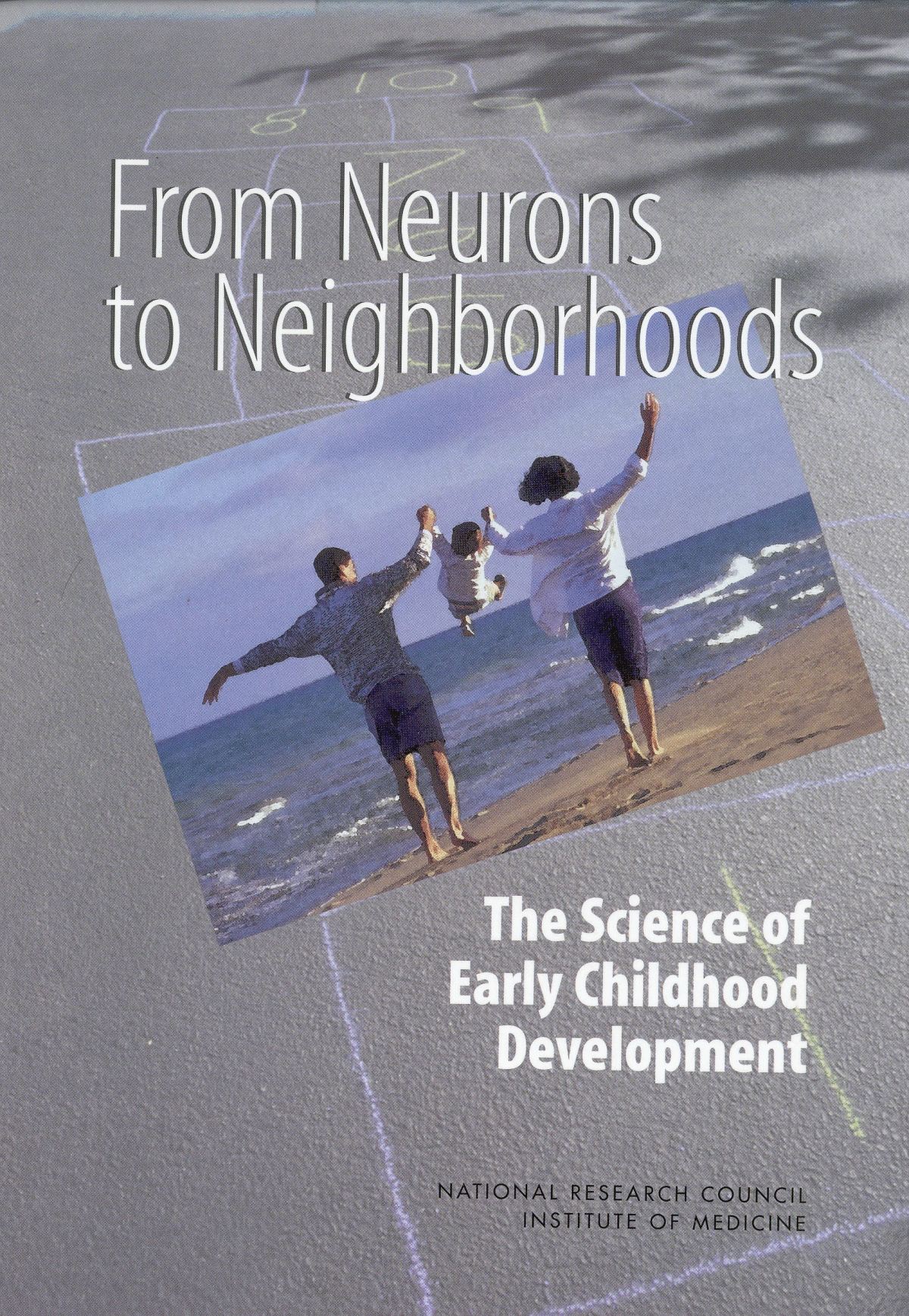
Inspired by The Carter Center’s Atlanta Project and the report From Neurons to Neighborhoods issued by the Committee on Integrating the Science of Early Childhood Development, Dr. Brumley visited Atlanta’s neighborhoods to identify where his resources and sphere of influence could be useful.
He landed in Edgewood, located between Emory University and Grady Hospital along the East/West MARTA rail line. At the time, the once working-class neighborhood experienced high poverty, teen pregnancy, and crime rates but strong community ties. Dr. Brumley knew that rallying the community around what was good for the children could interrupt negative cycles and strengthen community well-being. With that in mind, he reached out to Principal Betty Blasingame, the dynamic principal of Whitefoord Elementary School, to forge an alliance serving neighborhood families.
School Based Health
Dr. Blasingame immediately saw the potential of a school-based clinic to serve her student body which had extremely high incidences of asthma and sickle cell anemia leading to chronic absenteeism. In 1994, Dr. Brumley with former student, Dr. Veda Johnson, formed the Meridien Education Resource Group to operate the Whitefoord Elementary School Clinic using Emory physicians.
Shortly thereafter, the Brumleys made a grant to Families First to manage a Family Resource Center supporting the administration of the clinic and referral services for non-medical related family needs. This initial partnership laid the groundwork for decades-long investment in Edgewood.
In 2009, having refined the model, Dr. Johnson left the Whitefoord Community Program to develop a replication agency with Emory University’s School of Medicine known as PARTNERS for Equity in Adolescent and Child Health. PARTNERS has contributed to the formation of more than 140 school-based health clinics across the state of Georgia through planning grants and technical assistance.
Locally, the clinic that started at Whitefoord Elementary School evolved into a Federally Qualified Health Center in the Edgewood neighborhood with multiple school-based health clinics and an early care and learning center. In 2025, recognizing the need for economies of scale, Whitefoord Health merged with MedCura for a total footprint of 17 Health Centers, 6 of which are school-based.
Community Programs
The relationships established through the Whitefoord Clinic informed the Zeist Foundation of additional service gaps for Edgewood families. It also provided guidance to the Foundation’s traditional grantmaking through the lived experience of Edgewood families. Within the Edgewood neighborhood, the Foundation supported the Whitefoord Clinics expansion into the Whitefoord Community Program.
The first community driven program launched by the Whitefoord Community Program was an Early Learning Center which opened in 1998. The organization went on to develop several afterschool programs to keep youth curious, positively engaged, and physically active. Edgewood residents and Whitefoord Community Program consumers were invited to actively engage in the design and/or construction of each new endeavor.
In 2013 and 2017, Atlanta Public Schools consolidated Edgewood’s two schools, Whitefoord Elementary and Coan Middle, with campuses in the more affluent neighborhoods of Grant Park and Kirkwood. This decision reduced demand for Whitefoord Community Program afterschool activities.
Housing
Moved by the health toll low quality housing was exerting on Whitefoord Elementary students, the Foundation began exploring the purchase of Edgewood Housing Apartments. Then in early 2003 Atlanta Gaslight announced the sale of its 42-acre industrial site in Edgewood. Sembler Inc. purchased the site with plans to convert it into a big box retail district sparking concerns about gentrification and land speculation.
In response, Dr. Brumley affirmed his commitment to high quality affordable housing for Edgewood families through the formation of the Mayson Avenue Cooperative and the hiring of an Edgewood resident, Garry Long. He was charged with outreach to inform residents of plans for development in the neighborhood and galvanize participation in the neighborhood association and NPU-O meetings.
In 2005, the Foundation purchased the Edgewood Housing Apartments with the intention of renovating the buildings. They were in such poor condition however, redevelopment was necessary. The Foundation partnered with experienced affordable housing developer Columbia Residential to create rental townhomes designed with Edgewood Housing Apartment families in mind.
Following a model established by the Annie E. Casey Foundation in their East Baltimore revitalization work, Mayson Avenue Cooperative staff worked to ensure Edgewood Housing Apartment residents would have support and agency as they sought new housing during the re-development phase. Once construction was completed on the Retreat at Edgewood, legacy residents were invited to return. In 2012, the Retreat at Edgewood opened with 140 units.
In 2019, with the support of community stakeholders past and present, the Foundation composed a summary of the first quarter-century of placed based philanthropy benefitting Edgewood residents and beyond.
“Highlights and Reflections-The Zeist Foundation’s 25-year investment in the Edgewood Neighborhood.”
A City Changing
In the decade following construction of the Retreat at Edgewood, Atlanta secured corporate headquarters in the double-digits and a burgeoning film/tv production industry drawn by our weather, talent pool, logistical efficiency, cost of living, and favorable state incentives. Already present housing pressures were compounded by the pandemic. As a result, the cost of living and housing in Atlanta has skyrocketed, and Edgewood is no exception.
What were once vital programs for the majority of residents, continue to anchor those who benefit from Dr. Brumley’s and others’ foresight to preserve affordability within the neighborhood. However, the needs of this racially and socio-economically diverse neighborhood have shifted and so too has the place-based strategy of the Zeist Foundation. We continue to fund non-profits delivering programs to children and families in Edgewood. Staff who reside in Edgewood serve on community and non-profit boards serving the neighborhood. Lastly, the Foundation continues supporting similar work by providing technical assistance to organizations seeking to implement a community engagement strategy.